
Cloudflare Skills: What’s the Buzz?
Cloudflare recently launched Skills, a repository designed to simplify the creation of AI agents. It abstracts away the complexity involved in building these agents from the ground up. The initial chatter is primarily happening on platforms like Reddit, with developers curious about its potential and how it stacks up against other agent frameworks.
The rise of AI agents – autonomous entities capable of performing tasks – has been rapid. We've seen tools like AutoGPT and LangChain gain traction, but they often require significant coding expertise and infrastructure management. Cloudflare Skills aims to lower that barrier to entry, allowing developers to focus on what they want the agent to do, rather than how it should be built.
Essentially, Cloudflare is responding to a clear need in the market. Building AI agents is hard. It's not just about the large language models; it’s about connecting them to tools, managing state, and ensuring reliable execution. Skills attempts to provide a pre-built toolkit to address these challenges and make agent development more accessible.
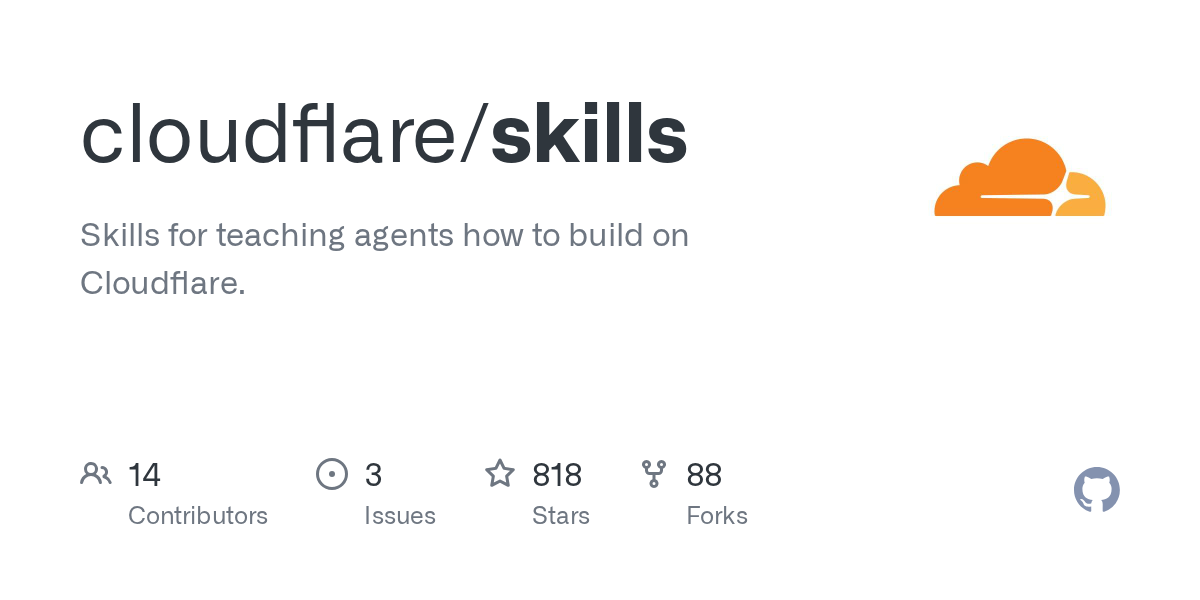
The Core Idea: Skills as Reusable Logic
The Cloudflare Skills repo is a collection of pre-built code snippets. These 'Skills' represent discrete units of functionality, like fetching data from an API, translating text, or performing a calculation. Think of them as Lego bricks for building AI agents. You select the bricks you need and connect them together to create a more complex structure.
This approach differs significantly from building agents from scratch, where you’d need to write all the code yourself. It also contrasts with using general-purpose libraries, which often require significant customization. Skills are designed to be immediately usable, with a focus on specific tasks. This means less boilerplate code and faster development cycles.
This abstraction means developers don't have to reinvent the wheel for common tasks. They can focus on the unique logic of their agent, rather than getting bogged down in the details of API calls or data parsing. It’s a move towards a more component-based approach to AI agent development.
What Kinds of Skills Are Available Now?
As of late November 2023, the Skills repo contains a growing, but still limited, set of Skills. They fall into several broad categories. There are Skills for data fetching, such as the "Google Search" Skill which allows an agent to query Google and retrieve results. There are also Skills for text processing, like summarization and translation, leveraging models available through Cloudflare.
Tool use is another key area. Skills can be created to interact with external APIs and services. For example, there’s a Skill for connecting to the OpenAI API, enabling agents to utilize GPT-3.5 or GPT-4. Cloudflare suggests building a simple agent that can answer questions about a company’s products by searching their documentation.
Currently, the Skills are primarily focused on relatively simple tasks. More complex operations, like image recognition or advanced data analysis, are not yet well-supported. The documentation explicitly states that Skills are not intended for long-running processes or tasks that require significant computational resources. The focus is on quick, reliable, and edge-based execution.
Here’s a breakdown of some available skills as of November 27, 2023:
* Google Search: Queries Google and returns results.
* OpenAI: Interacts with the OpenAI API.
* Zapier: Connects to Zapier for workflow automation.
* Weather: Fetches current weather conditions.
* Wikipedia: Searches Wikipedia and retrieves summaries.
How Does It Fit with Cloudflare Workers?
The integration with Cloudflare Workers is fundamental to the value proposition of Skills. Workers is Cloudflare’s serverless compute platform, allowing developers to deploy code to a global network of edge locations. This is a natural fit for AI agents, which often benefit from low latency and proximity to users.
Skills leverage the edge computing capabilities of Workers by allowing agents to run closer to the source of data and the end user. This reduces network latency and improves responsiveness. It also allows for more efficient use of resources, as processing is distributed across Cloudflare’s network.
Specific Workers features, like Durable Objects, can be particularly useful for building stateful agents. Durable Objects provide a way to store and manage data across multiple invocations of a Worker, allowing agents to maintain context and memory. This matters for tasks that require ongoing interaction or complex decision-making. The combination of Skills and Workers creates a powerful platform for building and deploying AI agents at scale.
Early Adopter Feedback: What Are People Saying?
The initial reaction to Cloudflare Skills, as evidenced by a recent Reddit thread, is a mix of excitement and cautious optimism. Many developers are intrigued by the promise of simplified agent development, but also express concerns about the limitations of the current Skill set. A common theme is the desire for more pre-built Skills, particularly those that integrate with popular services.
Several users have pointed out the importance of robust error handling and debugging tools. Since Skills are essentially black boxes, it can be difficult to diagnose issues when an agent fails. There are requests for more detailed logging and the ability to step through the execution of a Skill. One Reddit user, u/dev_x, commented, “It’s great that Cloudflare is making this easier, but I need to understand why something failed, not just that it failed.”
Another concern is the cost of using Skills, particularly in conjunction with external APIs like OpenAI. While Cloudflare Workers themselves have a generous free tier, the cost of API calls can quickly add up. Developers are asking for more transparency around pricing and usage limits. A user named u/ai_enthusiast stated, “I’m worried about the cost of running a complex agent with multiple API calls. Cloudflare needs to provide better cost estimation tools.”
Overall, the early feedback suggests that Cloudflare Skills has potential, but it’s still early days. Developers are eager to see the platform evolve and address these initial concerns.
Building a Simple Agent: A Conceptual Walkthrough
Let’s imagine you want to build an AI agent that summarizes news articles. Using Cloudflare Skills, you might start by selecting the "Google Search’ Skill to find relevant articles based on a given keyword. Then, you’d connect that Skill to a ‘Readability" Skill (if available, or a custom one) to extract the text content of the article.
Next, you’d use a "Summarization’ Skill to generate a concise summary of the article. Finally, you"d deploy this chain of Skills as a Cloudflare Worker, accessible via an API endpoint. When a user sends a request with a keyword, the Worker would execute the Skills in sequence, returning the summarized article.
You don't need to write the code for each of these steps. You simply select the appropriate Skills and connect them together. Cloudflare handles the underlying infrastructure and execution, allowing you to focus on the overall logic of the agent. This workflow drastically reduces the amount of code required and simplifies the development process.
Potential Use Cases Beyond the Basics
While simple summarization is a good starting point, Cloudflare Skills could be used for a wide range of more advanced use cases. Think about customer support bots that can answer frequently asked questions by searching a knowledge base. Or data analysis pipelines that automatically extract insights from various data sources.
Automated content creation is another possibility. An agent could be tasked with generating social media posts based on trending topics.blog articles based on a given topic. However, these more complex use cases would require a more extensive set of Skills and potentially custom code to handle the specific requirements. The current limitations around long-running processes and resource consumption would also need to be addressed.
One challenge is the need for reliable state management. For example, a customer support bot would need to remember the context of the conversation to provide relevant responses. This requires integrating Skills with Durable Objects or other stateful storage mechanisms. The potential is there, but it will require careful planning and implementation.
Where Do We Go From Here?
The future of Cloudflare Skills hinges on continued investment and community contributions. We can expect to see a growing number of pre-built Skills, covering a wider range of use cases. Improvements to the debugging and error handling tools are also likely, as are more transparent pricing and usage metrics.
The platform could also benefit from better support for custom Skills, allowing developers to easily create and share their own building blocks. This would foster a more vibrant ecosystem and accelerate innovation. Cloudflare may also explore integrations with other AI platforms and services, expanding the reach and capabilities of Skills.
Ultimately, Cloudflare Skills represents a promising step towards democratizing AI agent development. By abstracting away the complexity and providing a reusable toolkit, it has the potential to empower a new generation of developers to build intelligent applications at scale.

No comments yet. Be the first to share your thoughts!