
How interviews are changing
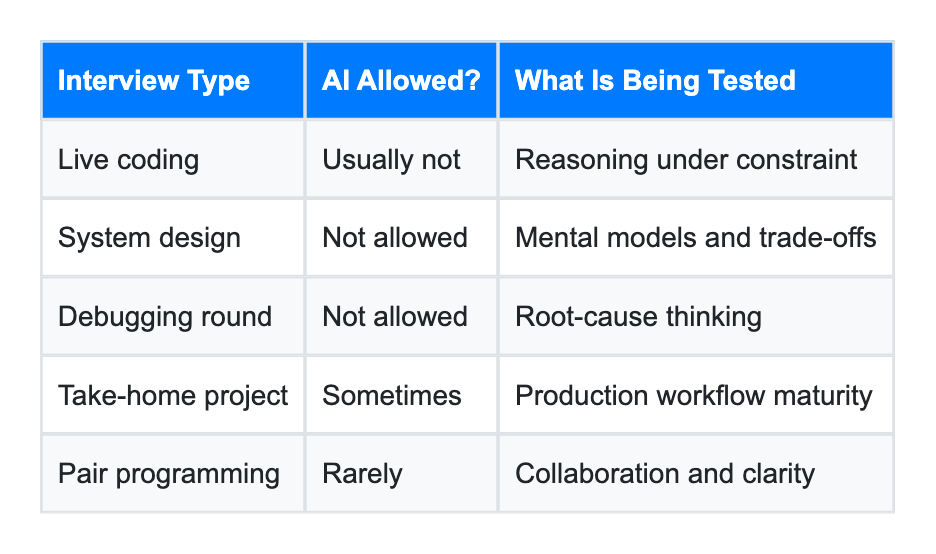
Technical interviews are moving away from Big O trivia. Most teams I talk to care more about how you solve problems than whether you've memorized a sorting algorithm. They want to see how you'll actually work on a Tuesday afternoon when a bug hits production.
You'll also notice system design questions creeping into interviews for even junior roles. This isn't about expecting you to architect the next Facebook; it’s about assessing your ability to think about scalability, trade-offs, and the broader impact of your code. The rise of remote work has further changed things, with asynchronous interviews and take-home assignments becoming increasingly common.
Take-home assignments, in particular, are a significant change. They allow companies to evaluate your coding style, testing practices, and ability to deliver a complete, working solution. Preparation, therefore, needs to be smarter, not just harder. It’s about showcasing your process and adaptability as much as your technical skills.
This means leaning into understanding why certain solutions work, and being able to articulate those reasons clearly. It also means practicing explaining your thought process out loud, even when coding alone. The ability to communicate technical ideas is just as important as being able to write the code.
Handling behavioral questions
Behavioral questions haven’t disappeared, but they’re becoming more nuanced. The standard "tell me about a time…" questions are still fair game, but interviewers are now probing for specific qualities like adaptability, learning agility, and conflict resolution within distributed teams. They want to see how you navigate ambiguity and collaborate effectively in a remote-first world.
The STAR method – Situation, Task, Action, Result – remains a useful framework for structuring your answers. However, simply stating that you’re a team player isn’t enough. You need to show it through concrete examples. Focus on the "Action" part of STAR, detailing specifically what you did and why.
I’ve recently seen questions like: 'Describe a time you had to quickly learn a new technology to unblock a project.' or 'Tell me about a situation where you disagreed with a teammate on a technical approach. How did you resolve it?' These questions assess your ability to learn, adapt, and navigate conflict constructively. Authenticity is key; don’t fabricate stories.
Prepare several stories that demonstrate these qualities. Think about projects where you faced challenges, learned from mistakes, and collaborated with others. Practice articulating these stories concisely and focusing on your contributions.
- Identify specific examples of when you had to learn a tool on the fly or handle a disagreement.
- Prepare STAR stories: Focus on situations that demonstrate these qualities.
- Be authentic: Don't fabricate experiences.
- Practice concise articulation: Clearly explain your actions and contributions.
The data structures you actually need
You still need to know your data structures. In 2026, I'm seeing more focus on hash tables, tries, and graphs. Don't just memorize the code; make sure you know why you'd pick a tree over a list in a real scenario.
Focus on understanding the trade-offs of each data structure. When is a hash table the right choice? When is a tree more appropriate? What are the time and space complexity implications? Being able to articulate these trade-offs demonstrates a solid understanding of the underlying principles.
Graphs are particularly important, given their wide applicability in real-world problems. Practice graph traversal algorithms (BFS, DFS) and common graph algorithms like Dijkstra’s algorithm and minimum spanning tree algorithms. Dynamic programming, while challenging, is also frequently asked. Start with simpler dynamic programming problems and gradually work your way up to more complex ones.
Don't fall into the trap of trying to memorize solutions. Instead, practice identifying the core problem and determining which data structure or algorithm is best suited to solve it. Resources like Codecademy and freeCodeCamp can be helpful for building a solid foundation, but prioritize understanding the concepts over simply completing exercises.
- Hash Tables: Understanding time/space complexity, collision resolution.
- Trees (especially Tries): Traversal, search, insertion, deletion.
- Graphs: BFS, DFS, Dijkstra’s, minimum spanning trees.
- Dynamic Programming: Identifying overlapping subproblems, memoization.
Data Structure Selection for Common Interview Problems
| Problem Type | Data Structure Options | Pros | Cons |
|---|---|---|---|
| Searching | Hash Table | Fast average-case lookup (O(1) on average). Efficient for checking existence of elements. | Performance degrades with many collisions. Requires a good hash function. Not efficient for ordered data. |
| Sorting | Array | Simple to implement. Good cache locality for small datasets. | Inefficient for large datasets (O(n^2) for simple sorts). Performance can be poor for nearly sorted data depending on the algorithm. |
| Relationships (Network Analysis) | Graph | Excellent for representing complex relationships between data points. Allows modeling of real-world networks. | Can be memory-intensive. Algorithms can be complex to implement and analyze. |
| Hierarchical Data | Tree | Efficient for representing hierarchical relationships. Enables efficient searching and sorting for ordered data. | Can become unbalanced, leading to worst-case O(n) performance. More complex to implement than arrays. |
| Searching & Ordered Data | Array (Sorted) | Simple to implement. Efficient for binary search (O(log n)). | Insertion and deletion can be slow (O(n)). Requires maintaining sorted order. |
| Lookup with Key-Value Pairs | Hash Table | Very fast lookups, insertions, and deletions on average (O(1)). | Order of elements is not guaranteed. Can have collision issues reducing performance. |
| Finding Paths/Shortest Routes | Graph | Well-suited for representing interconnected data and finding optimal paths. | Can be computationally expensive for large graphs. Requires careful algorithm selection. |
| Data with Parent-Child Relationships | Tree | Naturally represents hierarchical structures. Allows for efficient traversal and search within the hierarchy. | Can become unbalanced, affecting performance. Not ideal for representing many-to-many relationships. |
Illustrative comparison based on the article research brief. Verify current pricing, limits, and product details in the official docs before relying on it.
System design for everyone
System design interviews are no longer reserved for senior candidates. Even entry-level positions often include questions that assess your ability to think about the broader implications of your code. The core concepts of scalability, reliability, and maintainability are crucial. Interviewers want to see how you approach a problem from a holistic perspective.
Common system design interview questions include designing a URL shortener, a rate limiter, a caching system, or a simple search engine. The key isn’t to come up with a perfect solution – there often isn’t one. It’s about demonstrating your thought process and your ability to make informed trade-offs.
Start by clarifying the requirements. Ask questions about the expected scale of the system, the number of users, the read/write ratio, and any specific constraints. Then, break the problem down into smaller components. Consider different design choices and their implications. For example, how would you handle data storage? What database would you choose? How would you ensure high availability?
Don't be afraid to discuss different approaches and their trade-offs. Interviewers want to see that you can think critically and make informed decisions. Remember to consider edge cases and potential failure scenarios. A good system design interview is a collaborative discussion, not a monologue.
- Clarify requirements: Ask questions about scale, users, and constraints.
- Break down the problem: Divide it into smaller, manageable components.
- Consider trade-offs: Evaluate different design choices.
- Address edge cases: Think about potential failure scenarios.
Take-Home Assignments: A New Breed of Test
Take-home assignments are becoming increasingly prevalent, and they require a different approach than timed coding challenges. Treat them like mini-projects. This means focusing on code quality, testing, documentation, and overall maintainability. Companies are evaluating your ability to deliver a complete, production-ready solution.
Time management is crucial. Don’t try to over-engineer the solution or add unnecessary features. Focus on delivering a functional, well-tested, and documented solution within the given timeframe. It’s better to have a simple, well-executed solution than a complex, buggy one.
Don’t be afraid to ask clarifying questions, but avoid asking questions that you can easily answer yourself through research. Frame your questions thoughtfully and demonstrate that you’ve made an effort to understand the problem. Asking for clarification shows initiative and attention to detail.
Companies are looking for more than just a working solution. They want to see evidence of good coding practices, thorough testing, and clear documentation. Use meaningful variable names, write concise comments, and follow consistent coding style guidelines.
- Treat it like a mini-project: Focus on quality, testing, and documentation.
- Manage your time effectively: Prioritize essential features.
- Ask clarifying questions thoughtfully: Demonstrate initiative.
- Follow good coding practices: Use meaningful names, write comments.
Take-Home Assignment Focus
- Code Readability - Interviewers will scrutinize how easily they (and future teammates) can understand your code. Consistent formatting and meaningful variable names are crucial.
- Test Coverage - Demonstrating thorough testing shows you consider edge cases and potential bugs. Aim for high coverage, but prioritize testing critical functionality.
- Error Handling - Robust error handling isn't just about preventing crashes; it's about providing informative feedback. Think about how your code gracefully handles unexpected inputs or situations.
- Documentation - Clear, concise documentation explains why you made certain decisions, not just what the code does. This includes comments and potentially a README.
- Project Structure - A well-organized project is easier to navigate and maintain. Consider using appropriate directories and file names.
- Adherence to Instructions - This seems obvious, but carefully review the assignment requirements. Failing to meet specific criteria is a quick way to lose points.
- Scalability (If Applicable) - If the assignment hints at future growth, demonstrate awareness of scalability concerns. This doesn’t always mean implementing complex solutions, but showing you’ve considered them.
Tools and Resources to Level Up
There’s a wealth of resources available to help you prepare for technical interviews. Online learning platforms like Codecademy offer structured courses on data structures, algorithms, and system design. freeCodeCamp provides free coding exercises and projects to help you practice your skills. These are both excellent starting points.
For practice problems, explore platforms like LeetCode and HackerRank. While I hesitate to say LeetCode is the dominant platform, it remains a popular choice for many candidates. The Tech Interview Handbook also provides curated lists of resources and practice questions. GreatFrontEnd is a good option for front-end focused preparation.
Tools like Visual Studio Code and IntelliJ IDEA can greatly enhance your debugging and code analysis workflow. Familiarize yourself with the debugging features of your preferred IDE. Linters and code formatters can help you maintain consistent coding style.
Don't underestimate the value of books. Cracking the Coding Interview by Gayle Laakmann McDowell is a classic for a reason. It provides a comprehensive overview of the interview process and includes a wealth of practice problems. Remember to supplement these resources with real-world projects and contributions to open-source projects.
- Codecademy: Structured courses on data structures, algorithms, and system design.
- freeCodeCamp: Free coding exercises and projects.
- LeetCode/HackerRank: Practice coding problems.
- Tech Interview Handbook: Curated resources and questions.
- Cracking the Coding Interview: Comprehensive interview guide.
Featured Products

189 programming questions · Detailed solutions · Proven strategies
This classic guide provides a solid foundation of essential coding interview questions and their solutions.

Python-specific problems · In-depth explanations · Covers core computer science topics
Tailored for Python developers, this book dives deep into problem-solving techniques with clear, concise explanations.

201 real interview questions · Covers data science roles · Insights from top companies
Prepare for data science interviews with a comprehensive collection of questions and expert advice from leading tech and finance firms.
189 programming questions · Detailed solutions · Proven strategies
This classic guide provides a solid foundation of essential coding interview questions and their solutions.
As an Amazon Associate I earn from qualifying purchases. Prices may vary.

No comments yet. Be the first to share your thoughts!