
The 2026 shift in big tech interviews
Big tech interviews are moving away from whiteboard algorithm memorization. While you still need to know your data structures, companies like Google and Meta now prioritize how you design systems and handle team dynamics. They want to see if you can actually build and maintain code, not just solve puzzles.
This shift reflects how these companies operate. They're building and scaling complex systems, and they need engineers who can think critically about trade-offs, collaborate effectively, and write code that's not just correct, but also maintainable and scalable. The emphasis is moving away from pure problem-solving ability and toward evaluating candidates as potential leaders and contributors to large, ongoing projects.
Expect more behavioral questions designed to assess your leadership qualities, your ability to handle conflict, and your overall cultural fit. Technical rounds will increasingly focus on open-ended system design problems, requiring you to articulate your thought process and justify your design choices. The 'leetcode grind' alone simply won't cut it anymore. You need to show you can actually build things, and that you can work with others to do so.
Preparation for 2026 requires a more holistic approach. It’s about demonstrating not just what you know, but how you think, how you learn, and how you collaborate. This guide is designed to help you navigate this evolving landscape and increase your chances of success.
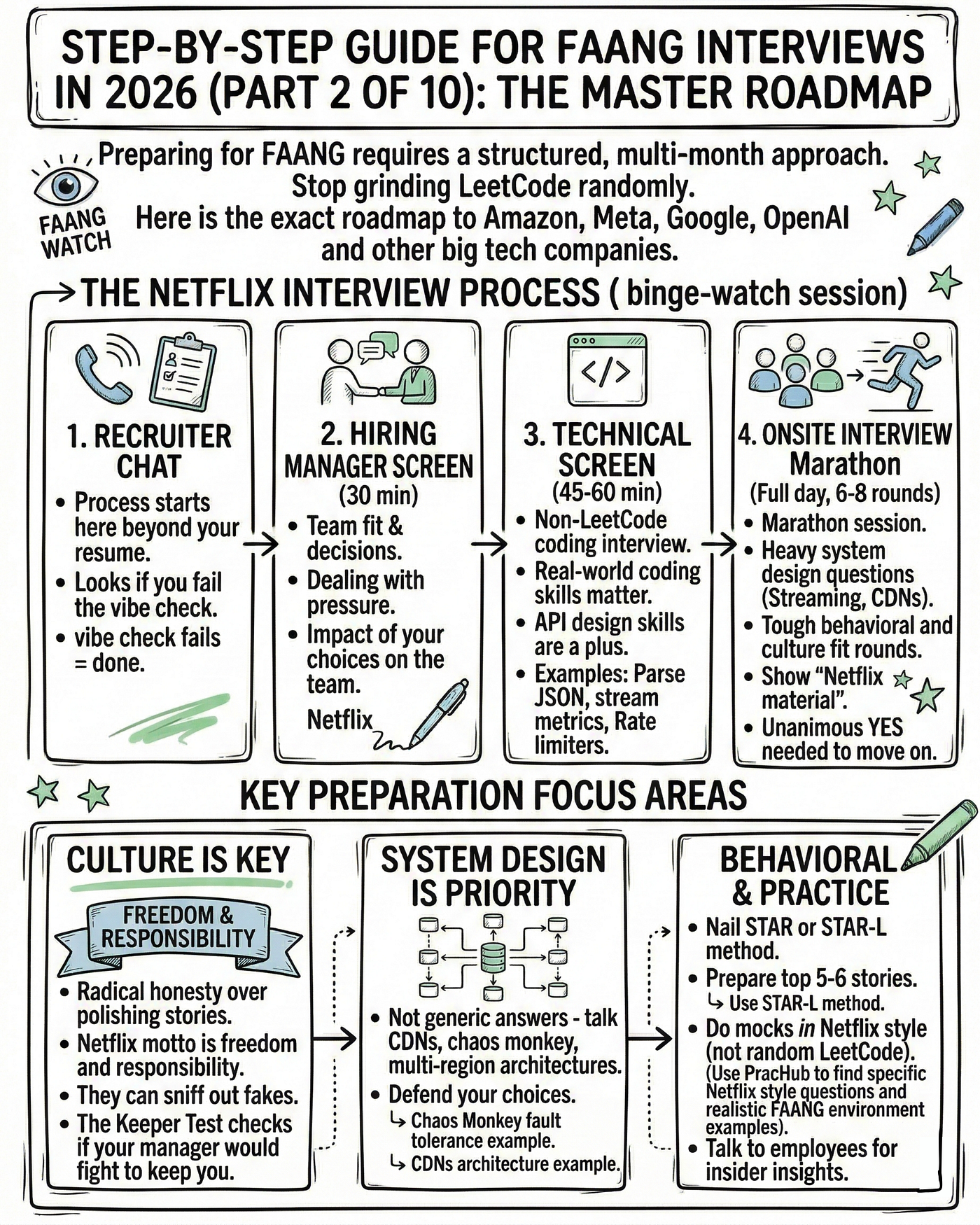
Skills that matter more than LeetCode
While platforms like LeetCode are valuable for sharpening your algorithmic skills, they represent only one piece of the puzzle. A truly comprehensive preparation strategy must extend far beyond memorizing solutions to common coding problems. You need a multifaceted skillset to impress FAANG+ interviewers.
First, system design fundamentals are non-negotiable. This includes understanding concepts like scalability, load balancing, database design (SQL and NoSQL), caching strategies, and message queues. You don't need to be an expert in every technology, but you do need to be able to discuss trade-offs and design systems that can handle real-world traffic. Knowing the difference between horizontal and vertical scaling, for example, is critical.
Second, behavioral interview preparation is often underestimated. The STAR method (Situation, Task, Action, Result) is your friend. Practice articulating your experiences in a clear, concise, and compelling manner. Be prepared to discuss your leadership style, how you handle conflict, and how you’ve overcome challenges. Companies are looking for candidates who can demonstrate emotional intelligence and work effectively in a team.
Third, a strong grasp of fundamental computer science concepts is essential. This includes operating systems (processes, threads, memory management), networking (TCP/IP, HTTP), and data structures. You should be able to explain these concepts at a high level and relate them to real-world scenarios. Don’t underestimate the importance of these foundational principles.
Finally, practical coding skills are paramount. Interviewers want to see that you can write clean, testable, and maintainable code. Focus on writing code that’s easy to read and understand, and be prepared to discuss your design choices. Don't just solve the problem; demonstrate that you can write production-quality code.
- System design: Focus on horizontal scaling and database trade-offs.
- Behavioral interview preparation – STAR method, leadership scenarios, conflict resolution
- Strong grasp of fundamental computer science concepts (OS, networking)
- Practical coding – ability to write clean, testable, and maintainable code
Common system design patterns
System design interviews aren’t about finding the "right’ answer. They"re about evaluating your thought process and your ability to make informed trade-offs. Interviewers want to see how you approach a complex problem, break it down into smaller components, and propose a solution that meets the specified requirements. Focus on understanding common patterns, not memorizing specific solutions.
Consider the challenge of designing a URL shortener (like bit.ly). Key considerations include generating unique short URLs, handling high traffic, and storing mappings between short and long URLs. You’d discuss using a hash function, a database (SQL or NoSQL), and caching to improve performance. The trade-off between collision probability and URL length is a crucial point to address.
Next, building a rate limiter is a common question. This involves controlling the rate at which users can access a resource. Algorithms like token bucket or leaky bucket are often discussed. You’d need to consider how to handle distributed rate limiting across multiple servers and how to prevent abuse. The choice between different algorithms depends on the specific requirements of the system.
Designing a distributed cache is another frequent topic. This involves caching frequently accessed data to reduce latency and improve performance. You’d discuss using technologies like Redis or Memcached, and consider issues like cache invalidation, consistency, and scalability. The trade-off between cache size and hit rate is a key consideration.
Finally, designing a social media feed requires thinking about data modeling, scalability, and real-time updates. You’d discuss using a graph database, a message queue, and a caching layer. You’d also need to consider how to handle personalization, filtering, and ranking of content. This is a complex problem with many potential solutions.
How to tell better stories
Behavioral questions are often the deciding factor in a FAANG+ interview. They reveal not just your technical skills, but also your personality, your work ethic, and your ability to collaborate. The key to success is mastering the STAR method: Situation, Task, Action, Result.
Let’s look at an example question: "Tell me about a time you had to deal with a difficult teammate.’ A weak answer might simply complain about the teammate. A strong answer, using the STAR method, would be different. Situation: ‘During a project to migrate our database to a new platform, I was working with a teammate who was consistently resistant to adopting new technologies.’ Task: ‘My task was to ensure a smooth and successful migration, and this resistance was hindering our progress.’ Action: ‘I scheduled a one-on-one meeting with my teammate to understand their concerns. I actively listened to their perspective and explained the benefits of the new platform, addressing their specific concerns with data and examples.’ Result: ‘Ultimately, my teammate came around and actively contributed to the migration. We successfully completed the project on time and within budget."
Another common question is: "Describe a time you failed.’ Authenticity is crucial here. Don"t try to present yourself as perfect. Instead, focus on what you learned from the experience. Explain what went wrong, what you did to mitigate the damage, and what you would do differently next time. Demonstrating self-awareness and a willingness to learn is highly valued.
Companies want to see that you can take ownership, handle ambiguity, and learn from your mistakes. Practice telling your stories concisely and effectively. Be prepared to discuss both successes and failures, and always focus on the lessons learned. Don’t be afraid to show your personality and let your genuine self shine through. A polished narrative is important, but authenticity is paramount.
- Step 1: Understand the STAR method (Situation, Task, Action, Result)
- Step 2: Identify key experiences that demonstrate leadership, teamwork, and problem-solving
- Step 3: Practice articulating your stories concisely and effectively
- Step 4: Be honest and authentic – don’t try to be someone you’re not
Coding Challenges: Real-World Examples
Beyond basic algorithm questions, FAANG+ interviews often present coding challenges that simulate real-world scenarios. These problems test your ability to design and implement solutions that are not only correct but also efficient and scalable. Expect to be asked to write code that handles edge cases and performs well under pressure.
Consider implementing a Least Recently Used (LRU) cache. This is a classic problem that tests your understanding of data structures and algorithms. You’d need to use a combination of a hash map and a doubly linked list to efficiently store and retrieve data. The key is to understand how to maintain the order of access and evict the least recently used items when the cache is full.
Another common challenge is designing a search autocomplete system. This involves implementing a data structure that can efficiently store and retrieve suggestions based on user input. A Trie (prefix tree) is often used for this purpose. You’d need to consider how to handle a large number of search queries and how to rank suggestions based on relevance.
Finally, implementing a thread-safe queue tests your understanding of concurrency and synchronization. You’d need to use locks or other synchronization primitives to ensure that multiple threads can safely access and modify the queue. This is a challenging problem that requires careful attention to detail. It is critical to understand the implications of race conditions and deadlocks.
- LRU Cache: Emphasize the use of hash maps and doubly linked lists for efficiency.
- Search Autocomplete: Demonstrate understanding of Tries for prefix-based search.
- Thread-Safe Queue: Highlight the importance of synchronization primitives to prevent race conditions.
LRU Cache Implementation: A Common FAANG Interview Question
The Least Recently Used (LRU) cache is one of the most frequently asked system design and data structure questions in FAANG interviews. This problem tests your understanding of hash maps, linked data structures, and time complexity optimization. Here's a clean, interview-ready implementation that prioritizes readability and demonstrates the core concepts.
class LRUCache:
    def __init__(self, capacity):
        """
        Initialize the LRU Cache with a given capacity.

        Args:
            capacity (int): Maximum number of items the cache can hold
        """
        self.capacity = capacity
        self.cache = {}  # Dictionary to store key-value pairs
        self.order = []  # List to track access order (most recent at end)

    def get(self, key):
        """
        Retrieve a value from the cache and mark it as recently used.

        Args:
            key: The key to look up

        Returns:
            The value associated with the key, or -1 if not found
        """
        if key not in self.cache:
            return -1

        # Move the accessed key to the end (most recently used)
        self.order.remove(key)
        self.order.append(key)

        return self.cache[key]

    def put(self, key, value):
        """
        Add or update a key-value pair in the cache.

        Args:
            key: The key to store
            value: The value to associate with the key
        """
        # If key already exists, update it and move to end
        if key in self.cache:
            self.cache[key] = value
            self.order.remove(key)
            self.order.append(key)
            return

        # If cache is at capacity, remove least recently used item
        if len(self.cache) >= self.capacity:
            lru_key = self.order.pop(0)  # Remove from front (least recent)
            del self.cache[lru_key]

        # Add new key-value pair
        self.cache[key] = value
        self.order.append(key)

# Example usage demonstrating the LRU cache behavior
if __name__ == "__main__":
    # Create cache with capacity of 3
    lru = LRUCache(3)

    # Add some items
    lru.put(1, "first")
    lru.put(2, "second")
    lru.put(3, "third")

    print(f"Get key 1: {lru.get(1)}")  # Returns "first", moves key 1 to end

    # Add fourth item - this will evict key 2 (least recently used)
    lru.put(4, "fourth")

    print(f"Get key 2: {lru.get(2)}")  # Returns -1 (evicted)
    print(f"Get key 1: {lru.get(1)}")  # Returns "first" (still in cache)
This implementation uses a dictionary for O(1) key lookups and a list to maintain access order. While this approach has O(n) time complexity for the put and get operations due to list operations, it clearly demonstrates the LRU eviction policy. In a real interview, you might discuss optimizing this to O(1) using a doubly-linked list with hash map, but this version effectively communicates your understanding of the problem requirements and provides a solid foundation for optimization discussions.
Staying Current: Trends for 2026
The technology landscape is constantly evolving, and FAANG+ interviews reflect these changes. To prepare for 2026, it’s important to stay abreast of emerging technologies and skills that are likely to be in high demand. Don’t just focus on what’s popular today; think about where the industry is headed.
Cloud computing (AWS, Azure, GCP) is becoming increasingly important. Companies are migrating their infrastructure to the cloud, and engineers need to be familiar with cloud services and architectures. Understanding concepts like serverless computing, containerization (Docker, Kubernetes), and infrastructure-as-code is crucial.
Machine learning fundamentals are also becoming increasingly valuable. Even if you’re not applying for a machine learning role, a basic understanding of machine learning concepts can be a significant advantage. Familiarize yourself with common algorithms, model evaluation techniques, and the ethical considerations of AI.
Distributed systems concepts will remain critical. As systems become more complex, the ability to design and build scalable, reliable, and fault-tolerant distributed systems is essential. Understanding concepts like consistency, availability, and partitioning is paramount.
Finally, cybersecurity awareness is increasingly important. Companies are facing growing threats from cyberattacks, and engineers need to be aware of security best practices. Understanding concepts like authentication, authorization, and encryption is essential.
FAANG+ Interview Preparation Platform Comparison (2026 Focus)
| Platform | Price | Difficulty Range | System Design Focus | Behavioral Prep | Community Support |
|---|---|---|---|---|---|
| LeetCode | Offers both free and premium subscriptions. Premium unlocks more problems and features. | Beginner to Advanced | Medium | Low | High |
| HackerRank | Free access to many challenges; paid subscriptions for additional features and certifications. | Beginner to Advanced | Low | Low | Medium |
| Interview Cake | Subscription-based; pricing available on website. | Intermediate to Advanced | Medium | Medium | Medium |
| System Design Primer | Primarily free, open-source resource. Donations accepted. | Advanced | High | Low | Medium |
Illustrative comparison based on the article research brief. Verify current pricing, limits, and product details in the official docs before relying on it.



No comments yet. Be the first to share your thoughts!