
The 2026 Interview Shift
Coding interviews are changing. In 2026, expect less focus on memorizing algorithms and more on practical problem-solving, system design, and behavioral skills. Companies want assessments that reflect actual work, not just puzzles.
Remote work means interviews often skip whiteboarding, pushing for better communication and articulation of thought processes. Take-home assignments are also increasing, testing coding style, testing practices, and the ability to deliver functional code. The goal isn't the 'perfect' solution, but how you approach a problem.
With high demand for experienced engineers, companies need candidates who adapt quickly. System design interviews are more common, even for mid-level roles. They want to see your understanding of scalability, reliability, and the trade-offs in building distributed systems. Theory isn't enough; application matters.
Behavioral questions are increasingly important. Companies know technical skills aren't everything; they want to assess soft skills, teamwork, and cultural fit. Expect deeper questions about your past experiences and how you handled challenges. Prepare thoughtful, structured answers.
LeetCode Patterns: The Core 10
Mastering LeetCode means recognizing patterns, not memorizing solutions. Certain approaches appear repeatedly, improving your efficiency and confidence. Here are ten core patterns common in FAANG interviews.
Sliding Window is used for problems involving finding a subarray or substring that satisfies a certain condition. It’s about maintaining a window of elements and moving it through the data, updating the window as you go. Common applications include finding the maximum sum subarray of size k, or the longest substring without repeating characters. The key is to avoid redundant calculations.
Two Pointers is effective for problems where you need to find pairs of elements that satisfy a certain condition. It's often used with sorted arrays to efficiently search for targets or find duplicates. Think of finding pairs that sum to a given target, or removing duplicates from a sorted array. This pattern is all about reducing time complexity.
Fast & Slow Pointers is particularly useful for detecting cycles in linked lists or finding the middle element of a linked list. The slow pointer moves one step at a time, while the fast pointer moves two steps at a time. If they meet, it indicates a cycle. This is a classic technique for handling linked list problems.
Merge Intervals focuses on combining overlapping intervals. It's commonly used in scheduling problems or when dealing with ranges of data. The core idea is to sort the intervals and then iteratively merge overlapping ones. This pattern demonstrates your ability to work with ranges and optimize data representation.
Cyclic Sort is a clever technique for problems involving arrays containing numbers in a specific range. It's used to rearrange the array so that each element is in its correct position. This pattern is often used to find missing numbers or duplicates in an array. It relies on understanding the properties of cyclic permutations.
Tree BFS/DFS are fundamental graph traversal algorithms. Breadth-First Search (BFS) explores the tree level by level, while Depth-First Search (DFS) explores as far as possible along each branch. Understanding when to use each algorithm is crucial for solving tree-related problems. They are the building blocks for more complex tree algorithms.
Graph Search expands on BFS and DFS to handle more general graph structures. You’ll use these algorithms to find the shortest path between nodes, detect cycles, or explore connected components. Familiarity with graph representations (adjacency lists and adjacency matrices) is essential.
Dynamic Programming is a powerful technique for solving optimization problems by breaking them down into smaller, overlapping subproblems. It’s often used to find the minimum or maximum value of something, like the shortest path or the longest common subsequence. Understanding memoization and tabulation is key to mastering this pattern.
Backtracking is used for problems that involve exploring all possible solutions. It’s often used to solve constraint satisfaction problems, like the N-Queens problem or Sudoku. The key is to systematically explore the solution space and prune branches that don’t lead to a valid solution. It’s a good approach when the problem has a limited solution space.
- Sliding Window
- Two Pointers
- Fast & Slow Pointers
- Merge Intervals
- Cyclic Sort
- Tree BFS/DFS
- Graph Search
- Dynamic Programming
- Backtracking
- Top K Elements
LeetCode Patterns for FAANG Interview Preparation
| Pattern | Common Use Cases | Difficulty |
|---|---|---|
| Sliding Window | Finding maximum/minimum subarray, substring search, average of subarrays | Medium |
| Two Pointers | Searching sorted arrays, finding pairs with a given difference, reversing a linked list | Medium |
| Fast & Slow Pointers | Detecting cycles in linked lists, finding the middle of a linked list | Medium |
| Divide and Conquer | Merge sort, quicksort, binary search, problems involving recursion | Hard |
| Dynamic Programming | Optimization problems, finding the longest common subsequence, knapsack problem | Hard |
| Backtracking | Generating combinations and permutations, solving Sudoku, N-Queens problem | Hard |
| Graph Traversal (BFS/DFS) | Finding shortest paths, detecting connected components, topological sort | Medium |
| Tree Traversal | Inorder, preorder, postorder traversal; finding the height/depth of a tree | Medium |
Illustrative comparison based on the article research brief. Verify current pricing, limits, and product details in the official docs before relying on it.
FAANG Questions: Recent Examples
Here are recent interview questions (past 6-12 months) illustrating these patterns, focusing on solutions, thought processes, and common pitfalls.
Google: Implement a Least Recently Used (LRU) cache. (Difficulty: Medium). This question tests your understanding of hash maps and doubly linked lists. The optimal solution involves using a hash map to store the key-value pairs and a doubly linked list to track the order of access. Time complexity: O(1) for get and put operations. Candidates often struggle with correctly updating the linked list when a key is accessed or evicted. The key is to understand how to efficiently maintain the order of access.
Amazon: Given a list of intervals, find the minimum number of conference rooms required. (Difficulty: Medium). This is a classic merge intervals problem. Sort the intervals by start time, then iterate through them, merging overlapping intervals. The number of non-overlapping intervals represents the minimum number of conference rooms needed. Time complexity: O(n log n) due to sorting. A common mistake is not handling edge cases correctly, such as empty input or intervals with the same start time.
Meta: Implement a function to check if a binary tree is a valid Binary Search Tree (BST). (Difficulty: Easy/Medium). This question tests your understanding of BST properties. Use an in-order traversal to check if the elements are sorted. Alternatively, you can use recursion to check if each node satisfies the BST property. Time complexity: O(n). Candidates often forget to handle duplicate values correctly.
Apple: Given a string, find the longest palindromic substring. (Difficulty: Medium). This can be solved using dynamic programming or the expand around center approach. Dynamic programming involves building a table to store whether a substring is a palindrome. The expand around center approach iterates through each character and expands outwards to find the longest palindrome centered at that character. Time complexity: O(n^2). A common mistake is not handling even-length palindromes correctly.
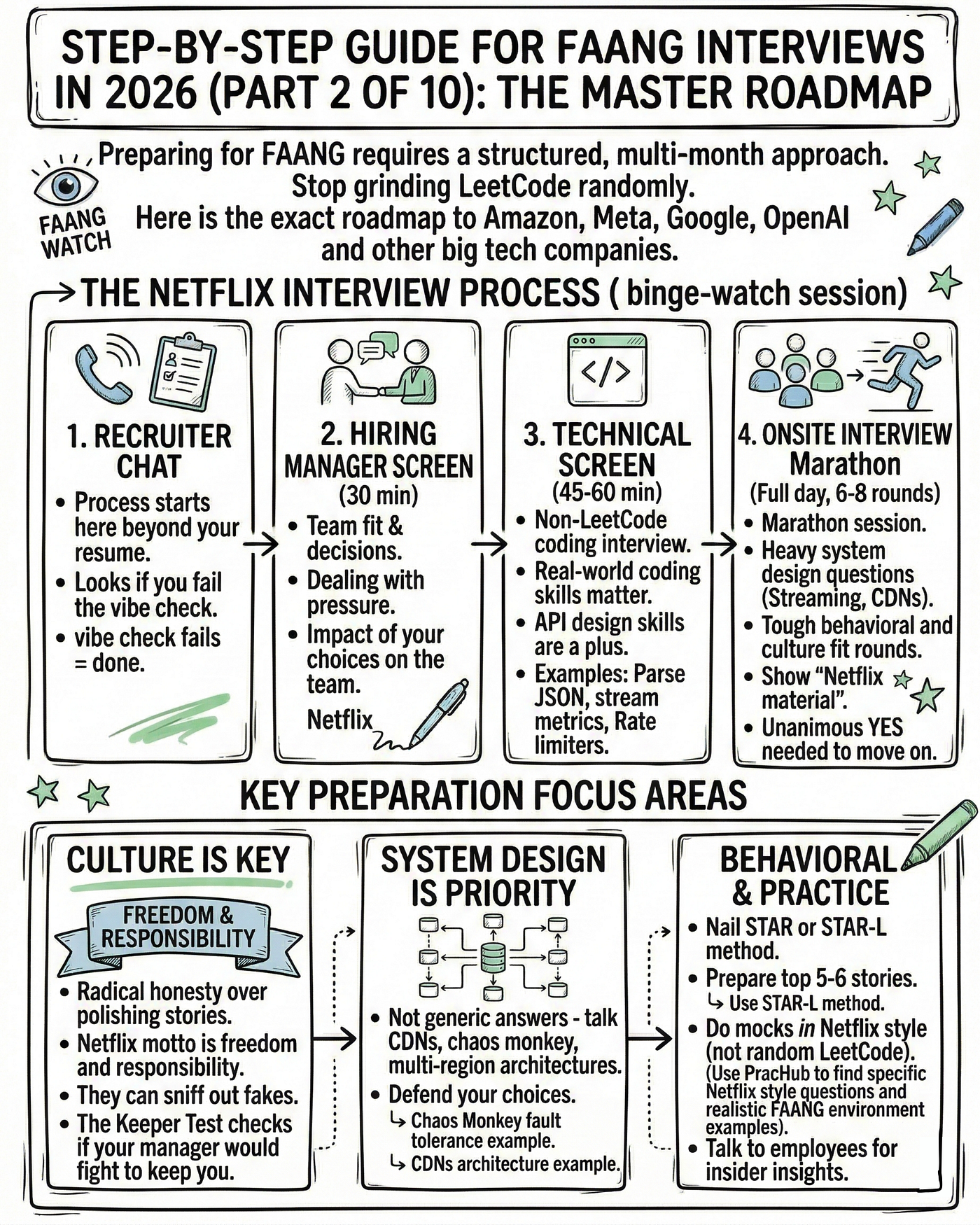
Netflix: Design a rate limiter. (Difficulty: Medium/Hard). This question assesses your system design skills. You need to design a system that limits the number of requests a user can make within a given time window. Common approaches include using a token bucket algorithm or a sliding window counter. Time complexity depends on the implementation. Candidates often overlook concurrency issues and scalability concerns.
LeetCode Patterns & FAANG Prep: Are You Ready?
So, you've been studying up on LeetCode patterns and diving into real FAANG interview questions – excellent! Now let's test your understanding. This quiz focuses on identifying the *right approach* to tackling common problems. Choose the best answer for each question. Good luck!
System Design: Beyond the Basics
System design interviews are now a standard part of the FAANG interview process, even for candidates with a few years of experience. It's not enough to know the theoretical concepts; you need to be able to apply them to real-world scenarios. Focus on understanding trade-offs and communicating your design choices clearly.
Common questions include designing URL shorteners, rate limiters, search autocomplete systems, and distributed caching systems. When tackling these questions, start by clarifying the requirements and constraints. What is the expected scale of the system? What are the performance requirements? What are the consistency requirements?
Key concepts to understand include scalability (horizontal and vertical), reliability (fault tolerance and redundancy), and consistency (CAP theorem). The CAP theorem states that it’s impossible for a distributed system to simultaneously guarantee consistency, availability, and partition tolerance. You’ll need to understand the trade-offs involved in choosing different consistency models. Eventual consistency is often a practical choice for many systems.
Don't just present a solution; discuss the alternatives and why you chose your approach. Be prepared to discuss potential bottlenecks and how you would address them. Think about caching strategies, database choices, and load balancing techniques. Remember, the interviewer is evaluating your thought process, not just your ability to come up with the 'right' answer.
Behavioral Questions: Storytelling Matters
Behavioral questions are often the most underestimated part of the interview process. They’re your opportunity to demonstrate your soft skills, your ability to work in a team, and your cultural fit. The STAR method (Situation, Task, Action, Result) is your best friend here.
The STAR method provides a structured way to answer behavioral questions. Situation: Describe the context of the situation. Task: Explain the task you were assigned. Action: Detail the specific actions you took to address the task. Result: Describe the outcome of your actions and what you learned. Be specific and quantify your results whenever possible.
Common behavioral questions include: Tell me about a time you failed. Describe a time you had to work with a difficult teammate. Tell me about a time you had to make a difficult decision. Describe a time you had to learn something new quickly. Prepare 2-3 strong stories that you can adapt to different questions.
Authenticity is key. Don’t try to fabricate stories or embellish your accomplishments. Be honest about your failures and what you learned from them. Tailor your stories to the specific company and role. Research the company’s values and culture and highlight experiences that demonstrate those values. And always be prepared to answer follow-up questions.
Tools and Resources: Your Prep Stack
There’s a wealth of resources available to help you prepare for your coding interviews. Here’s a curated list of tools and resources, with a realistic assessment of their strengths and weaknesses.
LeetCode: The gold standard for practicing coding interview questions. It has a massive library of problems, a strong community, and a good discussion forum. (Pricing: Free for basic access, Premium subscription for more features).
HackerRank: Similar to LeetCode, but with a stronger focus on competitive programming. It’s a good resource for practicing data structures and algorithms. (Pricing: Free).
AlgoExpert: A curated collection of coding interview questions with video explanations. It’s a good option if you prefer a more structured approach. (Pricing: Subscription-based).
Educative.io: Offers interactive courses on data structures, algorithms, and system design. It’s a good resource for learning the fundamentals. (Pricing: Subscription-based).
Interviewing.io: Provides mock interviews with experienced engineers from FAANG companies. It’s a great way to practice your interviewing skills and get feedback. (Pricing: Pay-per-interview).
Pramp: A peer-to-peer mock interview platform. You practice interviewing others and get interviewed in return. (Pricing: Free/Subscription).
Consistent practice and mock interviews are the most important aspects of your preparation. Don’t just focus on solving problems; focus on understanding the underlying concepts and being able to explain your thought process.
Staying Current: The Evolving Landscape
The tech industry is in constant flux, and the interview process reflects that. Staying up-to-date with the latest trends and best practices is crucial for success. Emerging technologies like AI/ML, WebAssembly, and serverless computing are increasingly impacting the types of questions you’ll encounter.
Expect to see more questions related to machine learning fundamentals, even if you’re not applying for an ML-specific role. Understanding concepts like model training, evaluation, and deployment is becoming increasingly important. Similarly, familiarity with WebAssembly and serverless computing can give you an edge.
Continuously learning and adapting is essential. Follow tech blogs, listen to podcasts, and attend conferences to stay informed. Resources like Hacker News, Reddit’s r/programming, and industry-specific newsletters can provide valuable insights. Don’t be afraid to experiment with new technologies and build personal projects to demonstrate your skills.



No comments yet. Be the first to share your thoughts!