
Cloudflare Agents and Durable Objects represent a significant shift in how we approach serverless applications. Traditionally, serverless functions have been stateless, making it difficult to build applications that require persistent state or complex logic at the edge. This new combination, launched in April 2025, addresses that limitation head-on.
The core idea is to bring stateful logic closer to your users, reducing latency and improving performance. It’s not simply another serverless offering; the combination unlocks new possibilities for applications like real-time collaboration tools and personalized experiences. Consider the limitations of constantly re-establishing connections and data transfers with centralized databases – Agents and Durable Objects aim to minimize those issues.
Cloudflare provides an Agent Starter repo (https://github.com/cloudflare/agents-starter) to help developers get up and running quickly. This framework provides the building blocks for creating AI-powered agents that can interact with Durable Objects, enabling a new generation of edge-native applications. A free Cloudflare account is all you need to begin exploring.
Agents excel in scenarios where maintaining state and executing complex logic close to the user is paramount. Think beyond basic chatbot implementations. Real-time gaming leaderboards, for example, demand low-latency updates and consistent state across a globally distributed player base. Traditional serverless functions struggle here due to cold starts and the overhead of constantly accessing remote databases.
Collaborative editing tools are another strong use case. Managing concurrent edits from multiple users without conflicts requires a persistent state that can be quickly accessed and updated. Session management for globally distributed users also benefits immensely, as Agents can store session data closer to the user, reducing latency and improving the user experience. Running AI models at the edge is also improved with Agents; processing data closer to the source lowers response times.
The inherent limitations of traditional serverless architectures – their stateless nature and susceptibility to cold starts – create bottlenecks when dealing with these kinds of applications. Agents and Durable Objects provide a solution by allowing you to maintain state and execute logic directly on Cloudflare’s edge network. This results in faster response times, reduced costs, and a more seamless user experience. The ability to run more complex operations without repeated database access is a major advantage.
A Durable Object is essentially a globally distributed, stateful store optimized for low-latency access. Unlike traditional databases, Durable Objects are designed to hold relatively small amounts of state – think kilobytes rather than gigabytes. They are uniquely identified and can only be written to by a single worker at a time, enforcing the 'single-writer' principle.
This single-writer principle is crucial for maintaining data consistency. While it might seem restrictive, it simplifies the complexities of concurrent access and eliminates the need for complex locking mechanisms. Workers interact with Durable Objects by sending messages, triggering specific operations. The Durable Object then processes the message and updates its state accordingly.
It’s important to understand that Durable Objects aren’t replacements for databases like PostgreSQL or MySQL. They are designed for scenarios where you need to maintain small amounts of state and access it with extremely low latency. They function more like in-memory state stores, but with the added benefit of global distribution and persistence. They are ideal for things like game state, user session data, or configuration settings.
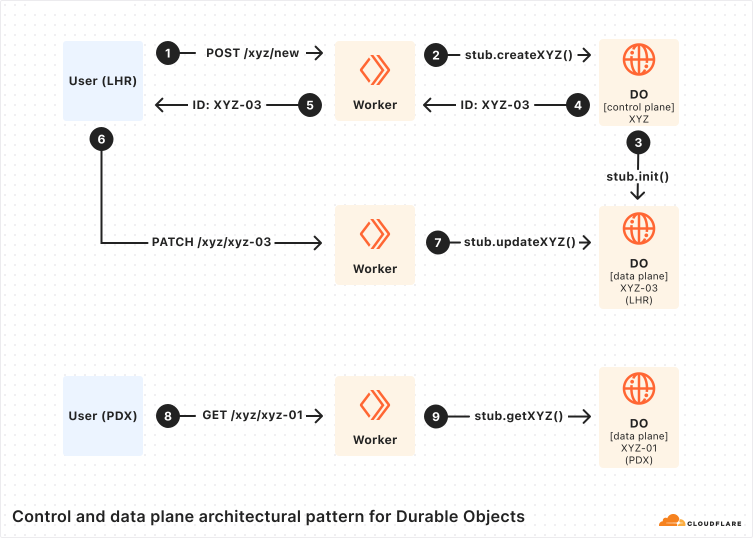
Cloudflare Agents act as the intelligent interface between external requests and the stateful logic residing within Durable Objects. When a request comes in, the Agent determines which Durable Object is relevant to that request and then orchestrates the necessary operations. This abstraction simplifies the development process, allowing you to focus on the core application logic rather than the complexities of routing and state management.
The Agent Starter repo provides a practical example of this interaction. It demonstrates how an Agent can receive a request, route it to the appropriate Durable Object, and then process the response. Agents aren’t limited to simple routing; they can also perform data transformations, authentication, and other pre-processing steps before interacting with the Durable Object.
Essentially, Agents handle the plumbing, so you don’t have to. They manage the complexities of the distributed environment, ensuring that requests are routed efficiently and that state is updated consistently. This allows developers to build sophisticated, stateful applications without getting bogged down in the details of infrastructure management. They are the control plane for your Durable Objects.
Let's consider a simple counter application. An Agent receives a request to increment the counter. This request is then routed to a specific Durable Object that stores the current counter value. The Agent instructs the Durable Object to increment its state – the counter – by one.
The Durable Object updates its internal state and returns the new counter value to the Agent. The Agent then returns this new value to the original requester. This process happens quickly and efficiently, thanks to the low-latency access provided by Durable Objects and the intelligent routing of the Agent.
This is a simplified example, but it illustrates the fundamental flow of data. The Agent acts as the intermediary, receiving requests, interacting with Durable Objects, and returning responses. The key takeaway is that the Agent handles the communication and orchestration, while the Durable Object focuses on maintaining the state.
While Agents and Durable Objects offer a powerful new approach to building serverless applications, it’s important to be aware of their limitations. The single-writer constraint of Durable Objects, while ensuring data consistency, can become a bottleneck in scenarios requiring high write concurrency. Careful design and partitioning of your state are crucial to mitigate this issue.
Debugging and monitoring distributed stateful applications can also be more challenging than with traditional serverless functions. You need to consider the flow of data between Agents and Durable Objects and ensure that you have the appropriate tools in place to track and diagnose issues. The ecosystem around Agents and Durable Objects is still relatively new, meaning the tooling and best practices are still evolving.
It’s essential to approach this technology with realistic expectations. It’s not a silver bullet, and it may not be the right solution for every use case. However, for applications that require persistent state, low latency, and edge-native performance, Agents and Durable Objects offer a compelling alternative to traditional serverless architectures.
The official Cloudflare documentation is the best place to start learning about Agents and Durable Objects: https://developers.cloudflare.com/agents/. The Agent Starter repo (https://github.com/cloudflare/agents-starter) provides a hands-on example to help you get started quickly. You can also find helpful tutorials and resources on serverless and edge computing platforms.
For a practical introduction, check out the YouTube video on building your first AI agent with Cloudflare: https://www.youtube.com/watch?v=82486227-1999-4410-b13a-ba652b0c61e0. Exploring these resources will give you a solid foundation for building stateful applications on the edge.
No comments yet. Be the first to share your thoughts!